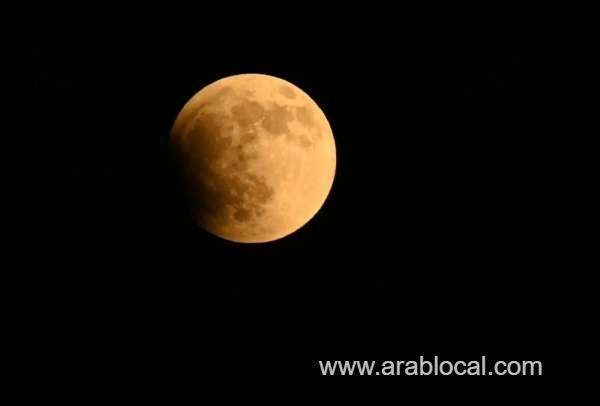
The skies above Saudi Arabia turned crimson on the evening of September 7, 2025, as a rare total lunar eclipse—one of the decade’s longest bathed the moon in a deep red glow.
Key Phases of the Blood Moon Eclipse
The lunar eclipse unfolded in stages: a partial eclipse began at 7:27 p.m. Saudi time, leading into totality from 8:30 to 9:53 p.m., with the entire celestial event concluding by 11:57 p.m.
Why the Moon Turned Red
As explained by Eng. Majed Abu Zahra, President of the Jeddah Astronomical Society, the Earth’s atmosphere filtered out shorter blue wavelengths during the eclipse, casting a red-copper hue across the lunar surface—hence the nickname “Blood Moon.”
The Significance and Rarity of the Eclipse
This total lunar eclipse stood out not only for its remarkable duration—totality lasted over 83 minutes—but also because eclipses of this length have not been seen since 2018.
A Photographer’s Paradise
Astrophotographers seized the opportunity to capture high-resolution imagery of each phase partial, total, and waning through telescopes equipped with digital cameras and specialized processing techniques.
Understanding the Science Behind Lunar Eclipses
A lunar eclipse happens when Earth lines up between the Sun and the Moon, casting a shadow on the lunar surface. Because the moon’s orbit is tilted by about 5°, full alignment and thus totality only occurs occasionally.