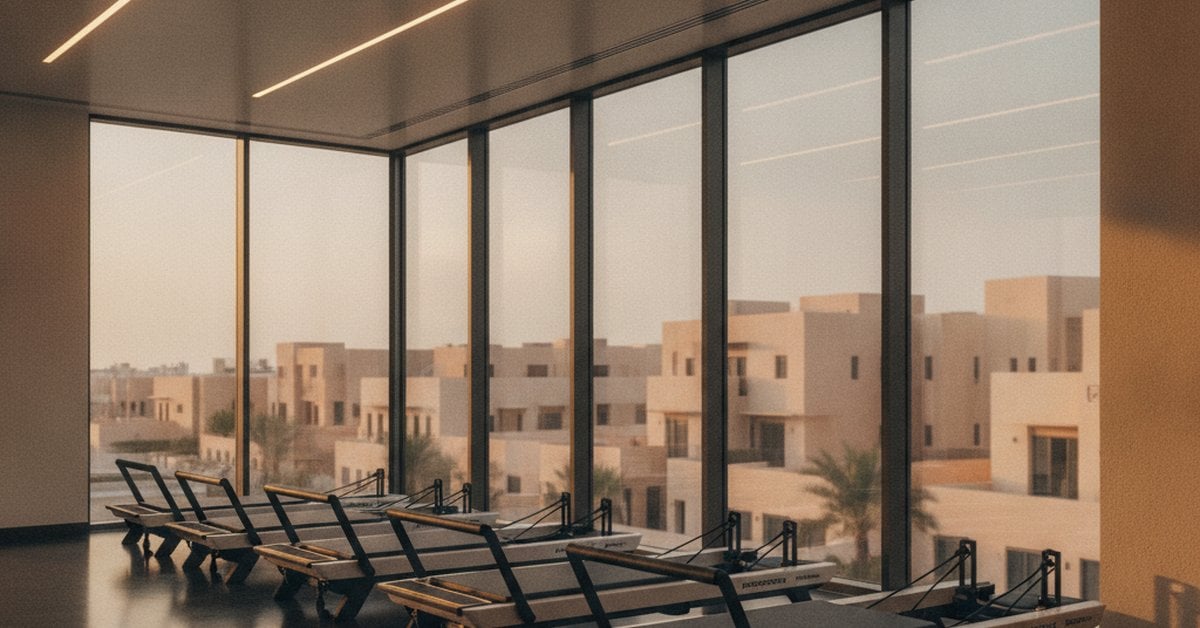
For professionals who divide their time between Dubai and Riyadh, particularly those with regular business in the Diplomatic Quarter or the wider DIFC ecosystem, the question of where to maintain a consistent fitness routine has become considerably more interesting over the past two years. Riyadh's fitness landscape, long dominated by large commercial gym chains, is now home to a growing number of boutique studios offering the kind of specialized, small-format training that residents and frequent visitors alike have come to expect in Dubai. Reform Athletica Saudi Arabia is among the studios leading that shift, bringing a reformer and Megaformer-based training model to the city's Diplomatic Quarter.
A market moving quickly, and for structural reasons
The growth underway in Saudi Arabia's fitness sector is not incidental. It is the direct result of policy under Vision 2030, which has positioned physical activity and wellness as a national priority linked to public health, economic diversification, and quality of life. Cumulative public investment in sports and wellness infrastructure is estimated in the billions of dollars over the past decade, and the health and fitness services market itself is projected to grow at a compound annual rate of close to ten percent through the end of the decade, according to industry research from MarkNtel Advisors.
What's actually happening here is more interesting than a simple gym-capacity story. According to GymNation's market analysis, the growth is concentrated in boutique and premium formats specifically — Pilates, reformer training, spin, personal conditioning — because demand has moved toward individualized training rather than the standard commercial gym floor. Riyadh sits at the center of that shift, alongside Jeddah and Dammam, driven by denser urban populations and lifestyle expectations that have evolved considerably in a short period.
The demographics behind this growth are worth understanding on their own terms. More than sixty percent of Saudi Arabia's population is under the age of thirty-five, according to Alora Advisory's market analysis — a population profile that, combined with rising disposable income and continued urbanization in cities like Riyadh and Jeddah, has produced a large and expanding pool of first-time fitness participants. That's a meaningfully different starting point from more mature, already-saturated fitness markets elsewhere in the region.
Why the boutique format resonates with this particular audience
Anyone already familiar with Dubai's boutique studios understands the appeal instantly once it exists in Riyadh too. A smaller class means an instructor can actually see what each person is doing — correcting form, adjusting resistance, catching the small errors that get lost entirely in a room of thirty. That level of oversight simply isn't available on a commercial gym floor, and it changes the consistency of the training itself, not just the atmosphere.
This matters most for clients whose lives don't stay in one city. Someone who has spent months building a routine around Reform Method or the Lagree Megaformer in Dubai doesn't want to trade it for a hotel treadmill the moment a Riyadh trip comes up. Being able to walk into a studio that trains the exact same way, at the same standard, removes one of the more disruptive parts of frequent business travel — and for a lot of clients, that continuity matters as much as the workout itself.
Scheduling is its own advantage here. A professional flying in for two days of meetings in the Diplomatic Quarter before heading back to the airport doesn't have room for a rigid membership structure built around monthly commitments. Boutique studios tend to work differently — booking a single class, on short notice, around a schedule that could shift at any moment — which suits the reality of business travel far better than the commercial gym model does.
The inclusivity dimension
Perhaps the most significant shift within Saudi Arabia's fitness sector has been the expansion of access for women. Multiple industry analyses now identify this as the fastest-growing segment of the market, with annual growth projected above thirteen percent between 2026 and 2031 — a trajectory made possible directly by Vision 2030 regulatory reforms, including the licensing of women-focused fitness facilities that simply didn't exist a decade ago.
Studios built to offer both ladies-only and mixed-gender classes have a genuine advantage in this landscape. One facility, one membership structure, and a client base spanning residents and visitors with meaningfully different preferences — rather than forcing that population to choose between two separate operations. As the market matures and expectations around access continue to shift, that flexibility becomes more valuable, not less.
What this growth signals for the wider region
What's happening in Saudi Arabia's fitness sector says something about where the wider Gulf is heading. Dubai has spent more than a decade as the region's default hub for boutique and premium training. Riyadh's growth suggests that's no longer a given — the two cities are converging toward comparable standards, rather than one leading and the other following. For anyone splitting their working life between the two, that convergence removes a compromise that used to be simply accepted as part of the arrangement.
What this means for Dubai-based visitors and residents
For anyone moving regularly between Dubai and Riyadh, or considering doing so more often as business between the two cities intensifies, one small friction point tends to matter more than it should: finding a Pilates class in Riyadh that actually holds up to the standard already familiar from home. Solving that removes one genuine source of disruption from an already demanding schedule. Fitness doesn't have to be something that gets paused the moment the flight lands — a well-established boutique studio lets the routine simply continue.
As Saudi Arabia's boutique fitness sector continues to mature in line with the broader Vision 2030 wellness agenda, the number of high-quality options available to residents and visitors alike is likely to keep expanding. For a client base already accustomed to Dubai's boutique studio culture, that growth represents a welcome and increasingly practical development — one that reflects a wider shift in how the region approaches fitness, wellness, and quality of life more broadly.