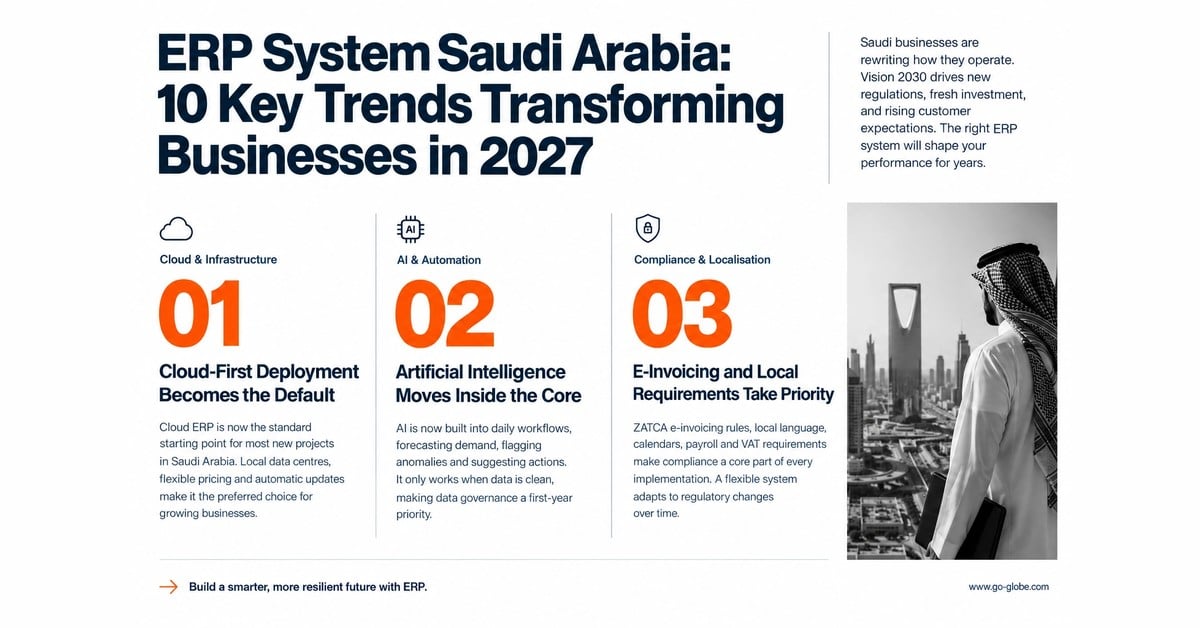
Saudi businesses are rewriting how they operate. Vision 2030 drives new regulations, fresh investment, and rising customer expectations. As a result, the ERP system Saudi Arabia companies choose today will shape their performance for years.
Over the past two decades, I have watched enterprise software move from heavy on-premise installations to flexible cloud platforms. However, the pace in the Kingdom now feels different. Regulators, giga-projects, and digital-native competitors push every organisation to modernise faster.
This guide explains ten trends that will define the ERP system Saudi Arabia market in 2027. Each section covers what is changing, why it matters, and what leaders should consider. Therefore, you can use it as a practical planning reference.
1. Cloud-First Deployment Becomes the Default
Cloud ERP is no longer a bold choice. It is now the standard starting point for most new projects in the Kingdom.
Several factors explain the shift. Local data centres from global providers have reduced latency concerns. Subscription pricing also lowers upfront costs, which helps growing companies. In addition, cloud platforms receive updates automatically, so finance teams stay current with regulatory changes.
Hybrid models still exist, particularly in government-linked and energy organisations. Even so, the direction is clear. Most buyers now ask how quickly a cloud ERP system in Saudi Arabia can go live, not whether it should run in the cloud.
2. Artificial Intelligence Moves Inside the Core
Until recently, AI in ERP meant a separate add-on. In 2027, it sits inside daily workflows.
Modern platforms now forecast demand, flag unusual transactions, and suggest purchase orders. Natural-language assistants also let managers ask questions in plain Arabic or English. For example, a finance director can request a cash-flow summary without building a report.
Importantly, AI works only when data is clean. Companies that neglect master data quality will see weak results. Therefore, data governance is becoming a first-year priority rather than an afterthought.
3. E-Invoicing Compliance Shapes Every Implementation
The Zakat, Tax and Customs Authority has expanded its e-invoicing rules in phases. Every business must now generate, store, and share invoices in approved formats.
Consequently, compliance has become a core selection criterion for any ERP system Saudi Arabia buyers consider. A platform must support structured invoice formats, QR codes, and secure integration with the national portal. Moreover, it must adapt quickly when new phases arrive.
Experienced finance leaders treat this as a continuous obligation. Rules evolve, and a rigid system creates risk. Flexible, regularly updated software reduces that exposure.
4. Deep Localisation Beyond Language
Translation alone no longer satisfies Saudi organisations. Localisation now covers the full operating environment.
Buyers expect support for Hijri and Gregorian calendars, right-to-left interfaces, and Arabic reporting. Payroll modules must also reflect Saudisation (Nitaqat) requirements, social insurance contributions, and the wage protection system. In addition, VAT and Zakat calculations must follow local rules precisely.
Global vendors have improved here, yet gaps remain. For this reason, many companies test localisation in a pilot before signing a contract. That step often reveals issues early, when fixes are still inexpensive.
5. Industry-Specific ERP Gains Ground
Generic systems struggle with specialised processes. As a result, vertical solutions are growing quickly.
Construction firms need project costing, subcontractor management, and progress billing. Logistics companies need fleet tracking and customs documentation. Healthcare providers need patient billing and insurance claims handling. Meanwhile, retailers need omnichannel inventory and loyalty features.
Giga-projects and large infrastructure programmes amplify this demand. Contractors and suppliers must meet strict reporting standards, so they need tools designed for their sector. A tailored ERP system Saudi Arabia providers configure for one industry usually delivers faster returns than a general-purpose build.
6. ERP and CRM Merge Into One Customer View
Finance and sales teams once worked in separate systems. That separation caused delays, duplicate entries, and confusion over customer data.
Today, companies connect ERP and customer platforms so that quotes, orders, and invoices flow without re-keying. This trend is especially visible in commercial hubs along the Red Sea coast. Many trading, retail, and service businesses there now evaluate CRM software Jeddah vendors alongside ERP options, because a single customer record improves both sales and collections.
Integration also helps leaders forecast revenue with more confidence. When pipeline data meets inventory and billing data, planning becomes far more reliable.
7. Mobile and Self-Service Access Expands
Saudi Arabia has one of the highest smartphone adoption rates in the region. Unsurprisingly, employees expect enterprise tools to work on their phones.
Mobile ERP now supports expense approvals, leave requests, inventory checks, and field service updates. Sales teams can also create orders on-site. Similarly, managers can approve purchase requests while travelling.
Self-service portals extend this idea to suppliers and customers. They can check statements, track deliveries, and submit documents without calling anyone. Consequently, back-office teams spend less time answering routine questions.
8. Real-Time Analytics Replaces Monthly Reporting
Waiting for month-end reports no longer works in a fast market. Leaders want live dashboards.
Modern systems consolidate finance, supply chain, and workforce data in one place. Executives can then monitor margins, stock levels, and receivables daily. Furthermore, alerts notify managers when a metric moves outside a set range.
This capability also supports multi-entity groups, which are common in Saudi family businesses and holding companies. Consolidation that once took weeks can now happen in hours. Naturally, better visibility leads to faster decisions.
9. Cybersecurity and Data Residency Take Priority
Data protection rules have tightened across the Kingdom. The Personal Data Protection Law and National Cybersecurity Authority controls both influence software choices.
Buyers now ask where data is stored, who can access it, and how long it is retained. They also ask about encryption, audit trails, and role-based permissions. In regulated sectors, these questions often decide the final vendor selection.
An ERP system Saudi Arabia organisations trust must therefore demonstrate security by design. Regular penetration testing and clear incident response plans have become standard expectations. Without them, procurement committees hesitate.
10. Composable and Low-Code Approaches Support SMEs
Small and medium enterprises drive a large share of Saudi growth. They also face tight budgets and limited IT staff.
Composable ERP answers that need. Companies begin with finance and inventory, then add modules as they grow. Low-code tools further allow business users to build simple workflows without developers.
This approach reduces risk. Instead of a large, expensive rollout, teams adopt change in stages. Moreover, government programmes that encourage SME digitisation make this path increasingly attractive.
How to Prepare for These Trends
Trends matter only when they lead to action. Based on my experience guiding implementation projects, a few steps consistently help.
First, map your current processes before choosing software. Many failed projects begin with a feature list instead of a process review. Second, appoint a business owner, not only an IT lead. Third, clean your data early, because migration quality affects every later stage.
In addition, plan for training from the start. People adopt systems that they understand. Finally, review vendor roadmaps every year. A platform that keeps pace with regulation will protect your investment.
Conclusion
The Saudi market is moving quickly, and software expectations are rising. Cloud delivery, embedded AI, strict compliance, and tighter integration are reshaping what an ERP system Saudi Arabia businesses need. Likewise, security, flexibility, and CRM software Jeddah teams use now matter as much as features.
Organisations that plan carefully will gain clearer data, faster decisions, and smoother compliance. Those that delay may find the cost of change grows each year.
Companies such as GO-Globe, which works with ERP and CRM implementations across the region, often observe that successful projects begin with clear goals, clean data, and strong user adoption. Consider these lessons as you plan your own roadmap for 2027.